DARI KOMUNAL KE INDIVIDUAL: PERUBAHAN ORIENTASI TEMPAT TINGGAL DAN MASA DEPAN SOO LANGKE DAYAK TAMAN
DOI:
https://doi.org/10.33652/handep.v9i1.890Keywords:
soo langke, long house, dayak taman, and structuration theoryAbstract
In recent years, the soo langke, which has become the identity of the Taman community, has slowly begun to be abandoned. Of the dozens of bilik, only half are still inhabited because some residents have decided to live in single houses. This change is interesting to study to understand why this shift in lifestyle has occurred, the process of adaptation to individual life, and the future of soo langke as a tangible and intangible heritage. This discussion distinguishes this paper from others because most of them discuss cultural aspects and the impact after the longhouse was abandoned. To discuss this, data was collected over three years from 2022 to 2025 in three villages, namely Urang Unsa, Melapi, and Ariung Mendalam in Kapuas Hulu Regency. Data collection was carried out through interviews and observations. The results of the study show that the phenomenon of abandoned soo langke began to flourish since the introduction of the self-help housing stimulus assistance (BSPS) from the central government. The threat of fire and ease of mobility are strong reasons that encourage people to build single houses, even though in practice, the transition from communal to individual living is not easy because it changes the patterns and means of interaction among residents. The emptiness of soo langke is fully realized by the people of Taman. Custom does not prohibit people from living in single houses, but they must not abandon traditional ceremonies and must not act individually.In recent years, soo langke, which has become the identity of the Taman community, is no longer the primary form of residence. From dozens to tens of bilik, some of them are empty or no longer inhabited because residents choose to live in single houses. The number of ‘bilik’ (household unit within a longhouse, occupied by a nuclear or extended family) has declined significantly, with many now left unoccupied as residents increasingly choose to live in detached houses. This study examines the reasons behind this shift in residential preference, the process of adaptation to more individualised living arrangement, and the future of soo langke as a form of cultural heritage, drawing on Giddens’s structuration theory. To date, discussions of longhouses have primarily focused on their cultural significance and the consequences of their abandonment. Data were collected through interviews, observations, and documentation over a three-year period (2022-2025) in three villages (Urang Unsa, Melapi, and Ariung Mendalam) in Kapuas Hulu Regency. The findings show that, despite shifts in residential orientation, traditional structures have not collapsed but are instead reproduced in different forms through fragmented spatial practices. These shifts also reveal the emergence of social practices shaped by reflexive responses to everyday needs, including safety from fire, privacy, progress, and ownership of personal assets. Such changes are made possible by interplay between individuals agency and customary
structures, which both constrain and enable adaptation. Although soo langke no longer functions fully as a place of residence, it continues to serve as a centre for rituals, a symbol of kinship and communal identity, while also being reproduced through residents’ partial involvement. In this sense, soo langke has become an arena of negotiation between individual agency and the continuity of customary structures amid changing livelihood needs and development policies.
References
Alloy, Sujarni dkk. 2008. Mozaik Dayak Keberagaman Subsuku dan Bahasa Dayak di Kalimantan Barat. Pontianak: Institut Dayakologi
Anyang, Y.C. Thambun. 1998. Kebudayaan dan Perubahan Daya Taman Kalimantan dalam Arus Modernisasi: Studi Etnografis Organisasi Sosial dan Kekerabatan dengan Pendekatan Antropologi Hukum. Jakarta: PT. Grasindo.
Barker, Chris. 2005. Cultural Studies (terj). Yogyakarta: Kreasi Wacana
Frans L, S Jacobus dan Concordius Kanyan. 1994. Rumah Panjang Sebagai Pusat Kebudayaan Dayak dalam Paulus Flursu dkk (ed), Kebudayaan Dayak: Aktualisasi dan Transformasi. Jakarta: Gramedia
Endraswara, Suwardi. 2021. Metode Penelitian Kebudayaan. Yogyakarta: Gadjah Mada University Press
Enthoven, J.J.K. 1905. Sejarah dan Geografi Daerah Sungai Kapuas Kalimantan Barat (alih bahasa oleh P. Yeri, OFM). Pontianak: Institut Dayakologi.
Giddens, Anthony. 1984. The Constitution of Society: Outline of the Theory of Structuration. Oxford: Polity Press, Cambridge, in association with Basil Blackwell.
Giddens, A. (1984). The Constitution of Society: Outline of the Theory of Structuration. Berkeley: University of California Press
Hall, Stuart. 1990. “Culture Identity and Diaspora” dalam J. Rutherford. Identity: Community, Culture, Difference. London. Lawrence & Wishart.
Hartatik, 2009. “Rumah Panjang dan Perubahan Fungsinya Kajian Sosial Pada Masyarakat Dayak di Kabupaten Kutai Barat”, Naditira Widya Vol.3 No.2
---------. 2013. “Rumah Panjang Dayak Monumen Kebersamaan yang Kian Terkikis Oleh Zaman: Studi Kasus Dayak Kanayatn di Kalimantan Barat, Naditira Widya Vol.7 No. 1
Jones, Silvester Gerry. 2021. “Peristilahan dalam Pernikahan Adat Suku Dayak Taman Kapuas Kabupaten Kapuas Hulu”. Artikel Penelitian. Pontianak: Program Studi Pendidikan Bahasa Indonesia, Jurusan Pendidikan Bahasa dan Seni FKIP Untan
Lauer, Robert. H. 1993. Perspektif Tentang Perubahan Sosial. Jakarta: Penerbit Rineka Cipta
Masyarakat Taman. 2021. Buku Adat-Istiadat dan Hukum Adat Banuaka’ Taman. Melapi.
Mudiyono. 1994. “Perubahan Struktur Pedesaan Masyarakat Dayak: Dari Rumah Panjang ke Rumah Tunggal” dalam Paulus Florus dkk (ed). Kebudayaan Dayak Aktualisasi dan Transformasi. Jakarta: Gramedia
Moleong, Lexy J. 1994. Metodologi Penelitian Kualitatif. Bandung: Remaja Rosdakarya.
Pleasants, Nigel. 2019. “Free Will, Determinism and the ‘Problem’ of Structure and Agency in the Social Sciences”, in Philosophy of the Social Sciences, Vol. 49(1) 3 –30.
Putri, Elda Trialisa. 2017. Eksistensi Lamin Adat Pemung Tawai Sebagai Identitas Sosial Masyarakat Dayak Kenyah. Psikostudia: Jurnal Psikologi, Vol 6, No 2,
Ransa, Yulianus Sampe, Totok Priyadi, dan Seselia Seli. 2016. “Nilai Budaya dalam Ule’Ule’an Sastra Lisan Dayak Taman Kabupaten Kapuas Hulu” dalam Jurnal Pendidikan dan Pembelajaran Khatulistiwa 5(11): 1-18.
Ririn, Oktaviana Supriani, Diaz Restu Darmawan dan Efriani. 2021. “Tampir sebagai Ritual Peralihan dalam Upacara Kematian pada Suku Dayak Taman Kapuas di Kalimantan Barat”. Jurnal Ideas 7(4): 183-190.
Riwut, Tjilik. 2007. Kalimantan Membangun Alam dan Kebudayaan, Ed. Nila Riwut, Yogyakarta: NR Publishing.
Riwut, Tjilik. 2007. Kalimantan Membangun Alam dan Kebudayaan, Ed. Nila Riwut, Yogyakarta: NR Publishing.
Sedia, Genopepa. 2020. “Mengenal Adat kematian/Adat Pati Nyawa Dayak Taman di Kota Putussibau Kabupaten Kapuas Hulu”. Perahu 8(2):62-75.
Suryadi, Martholomeus. 2019. Konsep Ruang Simbolik Soo Langke Dayak Taman Kalimantan Barat Dalam Perspektif Filsafat Kebudayaan. Tesis Fakultas Filsafat. Universitas Gadjah Mada Yogyakarta
Suwarno. 2017. Budaya Huma Betang Masyarakat Dayak Kalimantan Tengah dalam Globalisasi: Telaah Konstruksi Sosial. Lingua, Vol. 14, No. 1.
Wulandari, Benedikta Juliatri Widi. 2010. Pesona Malapi dalam Bingkai Warisan Budaya Taman di Kabupaten Kapuas Hulu. Pontianak: BPSNT Pontianak
Wawancara. Modius Moja. Desa Melapi, Maret 2022.
Wawancara. Sekundus Maring. Desa Melapi, Maret 2022.
Wawancara. Kanserius Kandaran, Desa Ariung Mendalam, November 2023.
Wawancara. Jeranding. Desa Ariung Mendalam, November 2023.
Wawancara. Faustinus Suka Ranglut. Desa Ariung Mendalam, November 2023.
Wawancara. Giling. Desa Ariung Mendalam, November 2023
Wawancara. Alberta Banang. Desa Urang Unsa, Oktober 2025.
Wawancara. F. Iman. Desa Urang Unsa, Oktober 2025.
Wawancara. Lusia, Desa Urang Unsa, Oktober 2025.
Wawancara. Rupinus Tompok. Desa Urang Unsa, Oktober 2025.
Wawancara. Saludan. Desa Urang Unsa, Oktober 2025.
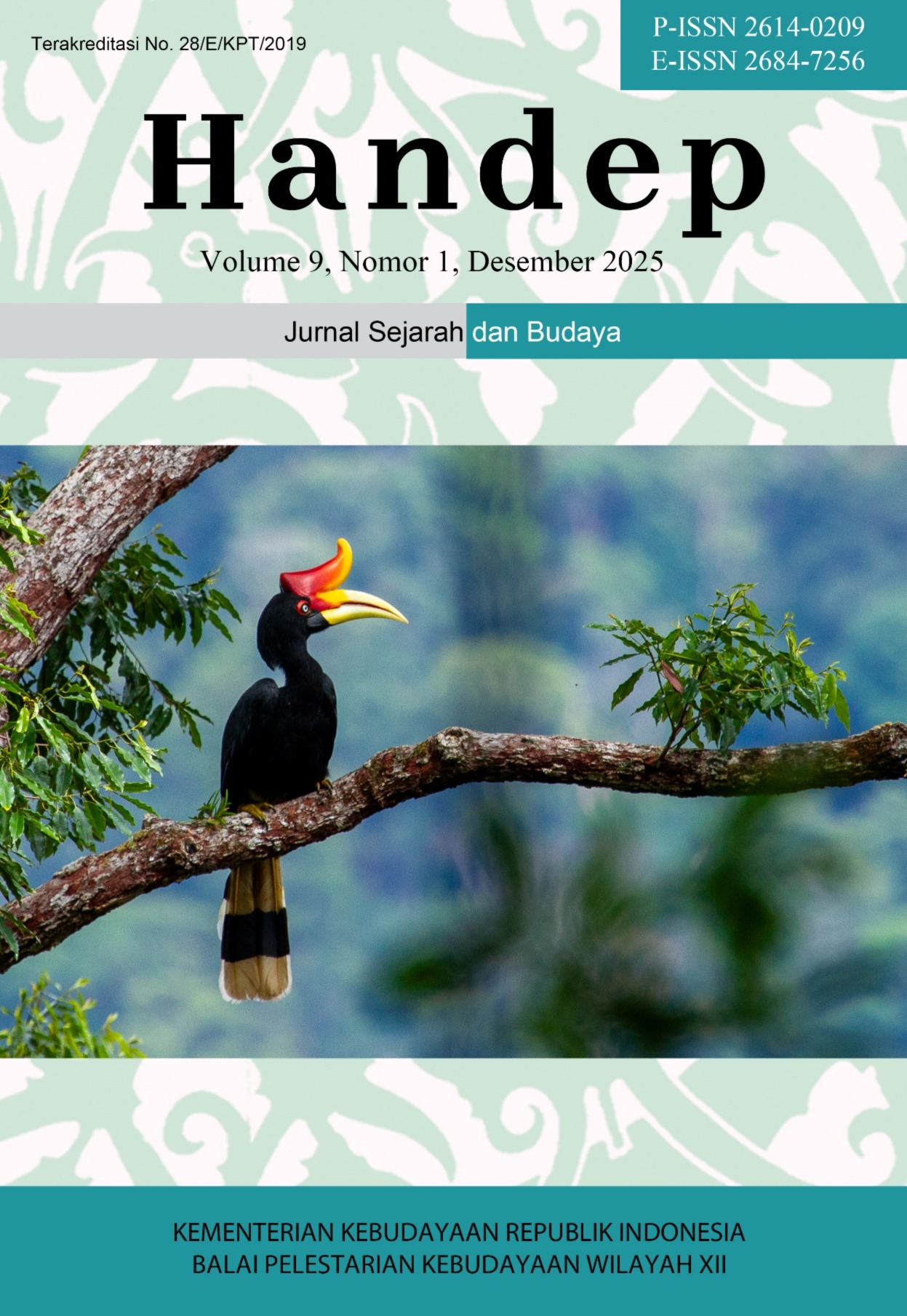
Downloads
Published
Issue
Section
License

This work is licensed under a Creative Commons Attribution-NonCommercial 4.0 International License.
By submitting the manuscript of papers/articles to Handep: Jurnal Sejarah dan Budaya, the authors are agreed to the following terms stated in copyright and license. Please also read our Publication Ethics dan Screening for Plagiarism.
Copyright
Authors who wish to publish and disseminate their papers with Handep: Jurnal Sejarah dan Budaya, shall agree to the publishing rights set by Handep: Jurnal Sejarah dan Budaya. Authors understand that they shall assign publication right to Handep: Jurnal Sejarah dan Budaya as part of the process upon acceptance for publication. The authors agreed that they will transfer certain copyrights to Handep: Jurnal Sejarah dan Budaya (authors must transfer the copyright by using the downloaded form HERE). Consecutively, authors still retain the right to use and share their own published articles without written permission from Handep: Jurnal Sejarah dan Budaya, as long as attributed properly, that the articles are initially published at Handep: Jurnal Sejarah dan Budaya.
Authors granted Handep: Jurnal Sejarah dan Budaya these following rights; (1) the right to publish and provide the manuscripts in all forms and media for publication and dissemination, (2) the authority to enforce the rights in the manuscript, for example in the case of plagiarism or copyright infringement.
License
Works in Handep: Jurnal Sejarah dan Budaya licensed under Creative Commons Attribution license. Users are free to copy and redistribute the material in any medium or format, remix, transform, and build upon the material under these terms; users must give appropriate credit, provide a link to the license, and indicate if changes were made. Users may do so in any reasonable manner, but not in any way that suggests the licensor endorses users or their usage.