TRANSFORMASI TRADISI LISAN MITI-MITI MENJADI SENI PERTUNJUKAN DI KEPULAUAN BATU, NIAS SELATAN
DOI:
https://doi.org/10.33652/handep.v8i2.698Keywords:
Miti-Miti, Tradisi Lisan, Pulau Tello, Warisan Budaya TakbendaAbstract
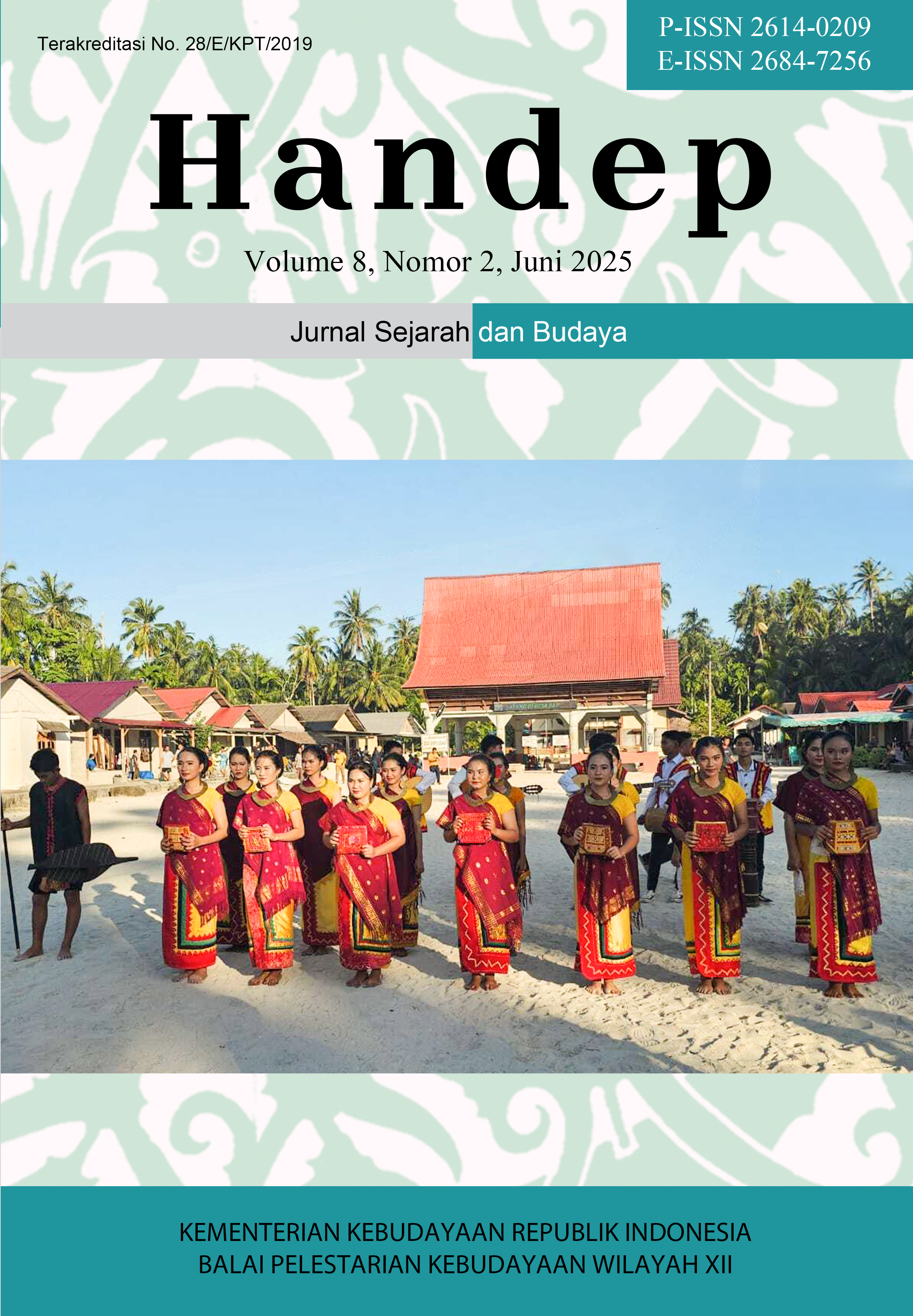
Miti-Miti is historically known as an oral tradition from Tello Island, South Nias. This oral tradition originated from the story of a young man who wished to express his feelings to a girl through a poem, which later came to be known as miti-miti. This study employed a descriptive qualitative approach. Primary data were collected through the observation of miti-miti performance videos, whereas secondary data were obtained from in-depth interviews and literature studies. The exact origins of miti-miti is unknown, it is believed existed before Indonesia’s independence. The incorporation of movements into the mitimiti tradition began during the Ya’ahowu Festival in 1978. These movements were adapted from the moyo, maena, and mogaele dances. The gesture involves hand swing while holding a bola nafo or a rena handkerchief as a prop. These movements symbolize the grace and serenity of Nias women. In addition, miti-miti is accompanied by traditional Nias musical instruments. The shifting function of oral traditions, miti-miti has transformed into a performing art, particularly in welcoming guests. Miti-miti is not only about reciting poems but also includes choreography that visually and symbolically communicates respect and hospitality. This indicates that the tradition remains active and is preserved by the Tello community.
References
Afif, Afthonula. 2010. “Le Lu h u r Oran g N Ias Dalam Ce Rita-Ce Rita Lis an N Ias Afth o n u l Afif.” Kontekstualita 25(1):53–79.
Anttonen, Pertti, Kirsti Salmi-niklander, and Studia Fennica. 2018. Oral Tradition and Book Culture.
B, I. Nyoman Muliana, Sokhizato Buulolo, and Aron Meko Mbete. 2023. Proceedings of the 2nd International Student Conference on Linguistics (ISCL 2022). Atlantis Press SARL.
Creswel, Jhon W. 2017. Research Design : Pendekatan Metode Kualitatif, Kuantitatif, Dan Campuran. Yogyakarta: Pustaka Pelajar.
Emeneau, M. B., and Albert B. Lord. 1962. “The Singer of Tales.” The Journal of American Folklore 75(295):67. doi: 10.2307/537850.
Fauziyah M, Sitti. 2015. “Faktor Sosiokultural Dalam Pemakaian Bahasa.” Jurnal Pemikiran Islam 1(1):154–74.
Fitra Youfika, Tedi Permadi, Sumiyadi, Dadang Sunendar, Lisan Sebagai, and Sarana Kontrol. 2023. “Ungkapan Kemarahan Masyrakat Etnid Pasemah Begkulu : Kajian Tradisi Lisan Sebagai Sarana Kontrol Sosial.” Jurnal Antropologi : Isu-Isu Sosial Budaya 25(1).
Hasanah, Luluk Ulfa (Universitas 17 Agustus 1945 surabaya), and Novi (Universitas 17 Agustus 1945 Surabaya) Andari. 2021. “10.25139/Fn.V4I1. 3232 -------------------------------------.” Jurnal Ilmiah FONEMA : Jurnal Edukasi Bahasa Dan Sastra Indonesia 4(2):48–66.
Hidayati, Dyah, and Balai Arkeologi Medan. 2014. “DENGAN PENGUBURAN DI PULAU NIAS BAGIAN SELATAN NIAS ETHNIC BURIAL IN BATU ISLAND AND ITS RELATION TO THE.” 121–39.
Josya Ryan Alexandro, Amoreta Luvena Adamasha Br, Ika Maya Sari Hutasoit. 2024. Kecamatan Pulau-Pulau Batu Dalam Angka. edited by M. S. Zebua. Nias Selatan: BPS Kabupaten Nias Selatan.
Laoli, Memori Perdamaian. 2016. “Pelaksanaan Pembagian Warisan Pada Masyarakat Adat Nias.” 1–19.
Lasmi, Ambia Nurdin, Ully Fitria, Kiki, Asrifa Dinen, and Reza Kurnia. 2024. “Tradisi Lisan Nandong Simeulue Pendekatan Antropolinguistik.” Public Health Journal 1(2):443–51.
Maknun, Moch Lukluil. 2019. Tradisi Lisan, Pendidikan Karakter Dan Harmonisasi Umat Beragama Di Era 4.0.
Markus, Manhart Thomas. 2004. “A Song for Lowalangi-The Interculturation of Catholic Mission and Nias Traditional Arts with Special Respect to Music.” Nus.
Moleong, LJ. 2006. “Metode Penelitian.” Raden Fatah.Ac.Id 1–23.
Rosliani. 2015. “Pandangan Masyarakat Dan Kearifan Lokal Cerita Rakyat Nias.” Ceudah 5(1):11–24.
Saryono. 2010. Metodologi Penelitian Kualitatif Dalam Bidang Kesehatan. Yogyakarta: Nuha Medika.
Sunarti, Sastri. 2021. “REPRESENTASI IDENTITAS Dan DEMOKRASI DALAM TRADISI LISAN DI WILAYAH 3T (MENTAWAI Dan NIAS).” JENTERA: Jurnal Kajian Sastra 10(1):108. doi: 10.26499/jentera.v10i1.3605.
Udu, Sumiman. 2015. “TRADISI LISAN BHANTI-BHANTI.” 27(1):53–66.
Utomo, C. B., & Kurniawan, G. .. 2017. “Bilamana Tradisi Lisan Menjadi Media Pendidikan Ilmu Sosial Di Masyarakat Gunungpati.” Harmony : Jurnal Pembelajaran IPS Dan PKN 2:169–84.
Viaro, Alain Mario, and Arlette Ziegler. 2006. “Traditional Architecture of Nias Island.”
Wati, Erna Ambar. 2023. “Tradisi Lisan Sebagai Sumber Sejarah.” Krinok: Jurnal Pendidikan Sejarah Dan Sejarah 2(1):52–59. doi: 10.22437/krinok.v2i1.24049.
Wootton, Kate L., F. Guillaume Blanchet, Andrew Liston, Tommi Nyman, Laura G. A. Riggi, Jens-peter Kopelke, Tomas Roslin, and Dominique Gravel. 2024. “Research Article.” 5(2):1–16.
Yanzi, Hermi. 2018. “( Strengthening of Oral Tradition in Order To Preserve.”
Zagoto. 2018. “Variasi Bahasa Nias : Sebuah Kajian Dialektologi.”
Sumber dari internet
Tello ku.2020. “Miti-Miti Pulau Tello, Kepulauan Batu – Nias Selatan.” YouTube. Published May 22, 2020. Retrieved November 1, 2024 from https://youtu.be/s8GG80SX0-E?si=JpGz0HuHx7M6TOQC
Tello – Indo. 2019. “Miti-Miti Asli Tello Tanah masa.” YouTube. Retrieved November, 1 2024. From : https://youtu.be/87zZUgHdpXk?si=MVLV-Lha_4wX70Y2
Museum Nias. 2024.”Tarian dan Musik Nias.” Museum Nias.Retrieved November 1, 2024. From https://museum-nias.org/tarian-musik/
Downloads
Published
Issue
Section
License
Copyright (c) 2025 Handep: Jurnal Sejarah dan Budaya

This work is licensed under a Creative Commons Attribution-NonCommercial 4.0 International License.
By submitting the manuscript of papers/articles to Handep: Jurnal Sejarah dan Budaya, the authors are agreed to the following terms stated in copyright and license. Please also read our Publication Ethics dan Screening for Plagiarism.
Copyright
Authors who wish to publish and disseminate their papers with Handep: Jurnal Sejarah dan Budaya, shall agree to the publishing rights set by Handep: Jurnal Sejarah dan Budaya. Authors understand that they shall assign publication right to Handep: Jurnal Sejarah dan Budaya as part of the process upon acceptance for publication. The authors agreed that they will transfer certain copyrights to Handep: Jurnal Sejarah dan Budaya (authors must transfer the copyright by using the downloaded form HERE). Consecutively, authors still retain the right to use and share their own published articles without written permission from Handep: Jurnal Sejarah dan Budaya, as long as attributed properly, that the articles are initially published at Handep: Jurnal Sejarah dan Budaya.
Authors granted Handep: Jurnal Sejarah dan Budaya these following rights; (1) the right to publish and provide the manuscripts in all forms and media for publication and dissemination, (2) the authority to enforce the rights in the manuscript, for example in the case of plagiarism or copyright infringement.
License
Works in Handep: Jurnal Sejarah dan Budaya licensed under Creative Commons Attribution license. Users are free to copy and redistribute the material in any medium or format, remix, transform, and build upon the material under these terms; users must give appropriate credit, provide a link to the license, and indicate if changes were made. Users may do so in any reasonable manner, but not in any way that suggests the licensor endorses users or their usage.