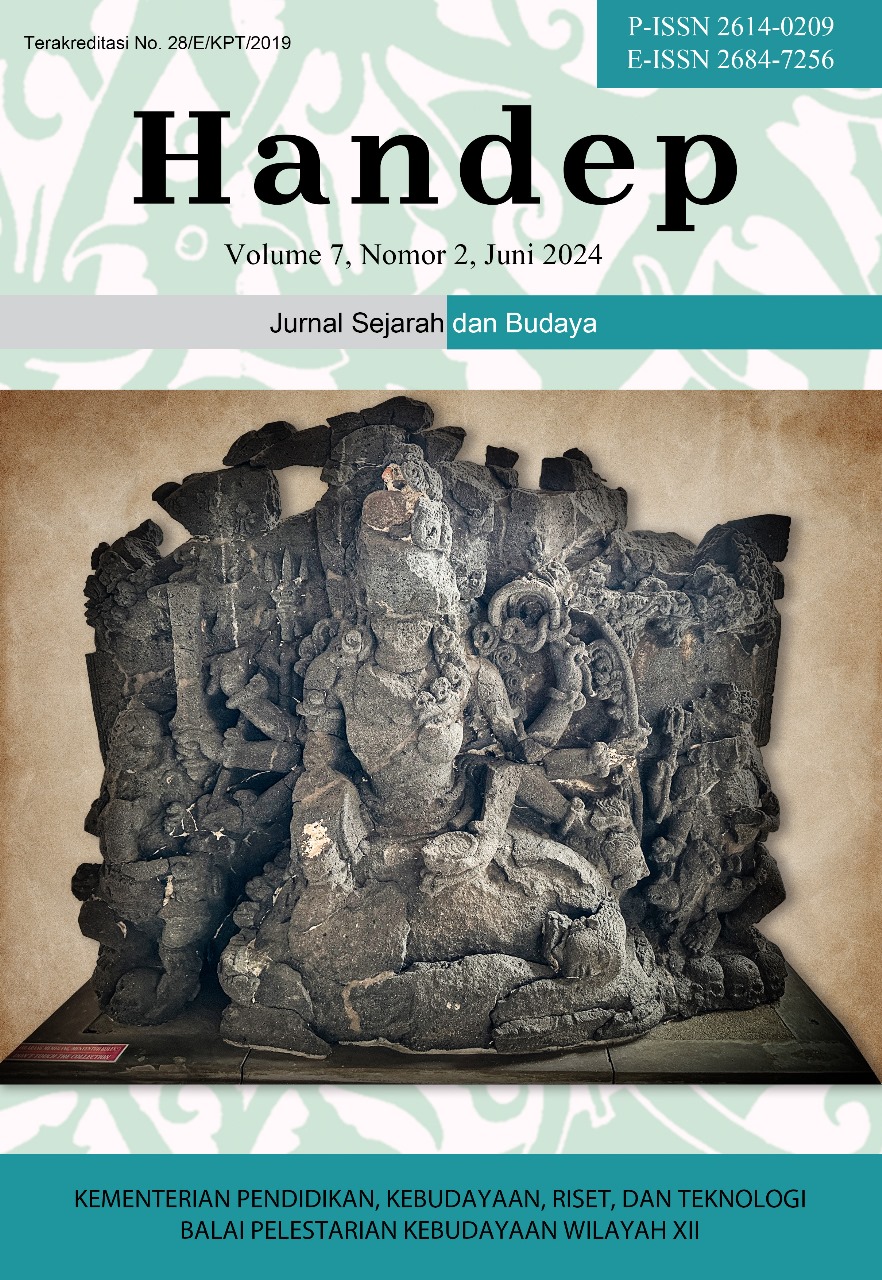
MENARASIKAN ULANG LABEL KOLEKSI ARCA CAMUNDI DI PUSAT INFORMASI MAJAPAHIT: SEBUAH TINJAUAN BIOGRAFI BENDA
DOI:
https://doi.org/10.33652/handep.v7i2.573Keywords:
Camundi statue, the statue role biography, presentation of collection narrative, and Majapahit Information CenterAbstract
This paper discusses the significance of presenting an educational, holistic, and neutral narrative of a museum collection according to the ICOM 2022 definition of a museum. The Camundi statue, one of the iconic collections of the Majapahit Information Center, is an essential example of museum curatorial bias. Visitors are highly interested in the historical journey of the Camundi statue; however, they lack access to a neutral and holistic information label from the collection. This research emphasises the biography of the Camundi statue's journey by examining the dynamics of the statue's role based on its meaning, research history, and preservation. The study applied a descriptive qualitative approach with the basis of historical archaeology and interpretation according to Igor Kopytoff's concept of the biography of things. The findings reveal ongoing debates among experts regarding the statue's identity and historical journey. The Camundi statue has undergone various transformations in its role, from a revered object of worship to a disaster relic, an item of preservation, and finally, a museum exhibit that should be presented without curatorial bias. The critical evaluation in this study recommends the re-narration of the collection label by considering four aspects of holistic, educative, and neutral narratives
References
Arbi, Yunus, Kresno Yulianto, R. Tjahjopurnomo, M. Ridwan A. Kosim, Osrifoel Oesman, dan Sukasno. 2011. Konsep Penyajian Museum. Jakarta: Direktorat Permuseuman Dirjen Sejarah dan Purbakala Kementerian Pariwisata dan Ekonomi Kreatif.
Berg, Cornelis Christiaan. 1951. “De Sadeng-oorlog en de mythe van Groot-Madjapahit.” Indonesië 5:385-422.
Boechari. 1959. “An Inscribed Lingga from Rambianak.” BEFEO 49.
Bosch, Frederik David Kan. 1928. Oudheidkundig Verslag 1928. Leiden: Martinus Nijhoff.
Callenfels, Pieter Vincent van stein. 1928. Oudheidkundig Verslag 1928. Leiden: Martinus Nijhoff. Damais, Louis-Charles. 1955. “Études d’épigraphie indoné sienne IV: Discussion de la Date des Inscriptions.” BEFEO 41(1):70290.
Dark, K. R. 1995. Theoretical Archaeology. New York: Cornell University Press.
Fahruddin, Ahmad, dan Y. Hanan Pamungkas. 2013. “Saiwasiddhanta Penelusuran Aliran Siwaisme di Jawa Timur Periode Klasik.” AVATARA, e-Journal Pendidikan Sejarah 1(2):241-54.
Fitroh, Nur Anah, dan Aminuddin Kasdi. 2017. “Peran Tribhuwana Tunggadewi dalam Mengembalikan Keutuhan dan Perkembangan Kerajaan Majapahit tahun 1328-1350.” AVATARA, e-Journal Pendidikan Sejarah 5(2).
ICOM. 2022. “ICOM Approves a New Museum Definition.” Diunduh 26 Januari 2024, (https://prague2022.icom.museum).
Kopytoff, Igor. 1986. “The Cultural Biography of Things: Commoditization as Process.” Hlm. 64-91 dalam The Social Life of Things– Commodities in Cultural Perspectives, disunting oleh A. Appadurai. Cambrigdeshire: Cambidge University Press.
Lehmannová, Martina. 2020. 224 Years of Defining The Museum. Ceko.
Majapahit, Direktori. 2021. “Henri Maclaine Pont.” Diunduh 26 Januari 2024, (https://direktorimajapahit.id/doku men/5/henri-maclaine-pont).
Moens,J. L. 1955. “Wisnuwarddhana. Vorst van Singhasari, en zijn Majapa hitse Santanapratisan-tana.” TBG 85.
Naerssen, F. H. van 1941. “Oudjavaansche Oorkonde in Duitsche en Deensche Verzamelingen.”
Perquin, P. J. 1928. “De Bhataragoeroe van Singosari.” dalam Oudheidkundig Verslag 1928. Leiden:
Martinus Nijhoff. Santiko, Hariani. 1987. “Kedudukan Bhatari Durga di Jawa pada Abad X-XV Masehi.” Disertasi, Program Studi Ilmu Arkeologi, Fakultas Ilmu Pengetahuan dan Budaya, Universitas Indonesia, Depok.
Sedyawati, Edi, Hasan Djafar, Ratnaesih Maulana, Wiwin Djuwita S. Ramelan, dan Chaidir Ashari. 2013. Candi Indonesia Seri Jawa. Hlm. 208-11, disunting oleh W. D. S. Ramelan. Jakarta: Direktorat Perlindungan Cagar Budaya dan Permuseuman Dirjen Kebudayaan Kemendikbud RI.
Simmons, John Edward. 2017. “History of Museums.” Encyclopedia of Library and Information Sciences 4:1812-23.
Stutterheim, Willem Frederik. 1932. “Oudheidkundig Aanteekenginen XVIII, Tjandi Bajalangoe en. Prajnaparamitapuri.” BKI 89:97-100.
Stuttherheim, W. F. 1934. “De Leidsche Bhairawa van Candi B Singasari.” TBG 74:441-76.
Suhadi, Machi, dan Richadiana Kartakusumah. 1996. Laporan Penelitian Epigrafi di Wilayah Provinsi Jawa Timur No 47. Jakarta: Proyek Penelitian Arkeologi Jakarta, Pusat Penelitian Arkeologi Nasional, Departemen Pendidikan dan Kebudayaan.
Utomo, Bambang Budi. 2009. “Majapahit dalam Lintas Pelayaran dan Perdagangan Nusantara.” Berkala Arkeologi 29(2):1-14.
Wasisto, Bertha L. A. 2009. “Candi Boyolangu: Tinjauan Arsitektur dan Arkeologis.” Skripsi, Program Studi Arkeologi, Fakultas Ilmu Pengetahuan dan Budaya Universitas Indonesia, Depok.
Yusuf, Muhamad Satok. 2021a. “Arca-Arca dan Candi Sumbernanas di Blitar Sebagai Karya Seni Masa Kadiri.” Tumotowa 4(2):107-20.
Yusuf, Muhamad Satok. 2021b. “Sumping Penanda Kesenian Arca pada Masa Kadiri-Singhasari.” Naditira Widya 15(1):15-30.
Downloads
Additional Files
Published
Issue
Section
License
By submitting the manuscript of papers/articles to Handep: Jurnal Sejarah dan Budaya, the authors are agreed to the following terms stated in copyright and license. Please also read our Publication Ethics dan Screening for Plagiarism.
Copyright
Authors who wish to publish and disseminate their papers with Handep: Jurnal Sejarah dan Budaya, shall agree to the publishing rights set by Handep: Jurnal Sejarah dan Budaya. Authors understand that they shall assign publication right to Handep: Jurnal Sejarah dan Budaya as part of the process upon acceptance for publication. The authors agreed that they will transfer certain copyrights to Handep: Jurnal Sejarah dan Budaya (authors must transfer the copyright by using the downloaded form HERE). Consecutively, authors still retain the right to use and share their own published articles without written permission from Handep: Jurnal Sejarah dan Budaya, as long as attributed properly, that the articles are initially published at Handep: Jurnal Sejarah dan Budaya.
Authors granted Handep: Jurnal Sejarah dan Budaya these following rights; (1) the right to publish and provide the manuscripts in all forms and media for publication and dissemination, (2) the authority to enforce the rights in the manuscript, for example in the case of plagiarism or copyright infringement.
License
Works in Handep: Jurnal Sejarah dan Budaya licensed under Creative Commons Attribution license. Users are free to copy and redistribute the material in any medium or format, remix, transform, and build upon the material under these terms; users must give appropriate credit, provide a link to the license, and indicate if changes were made. Users may do so in any reasonable manner, but not in any way that suggests the licensor endorses users or their usage.