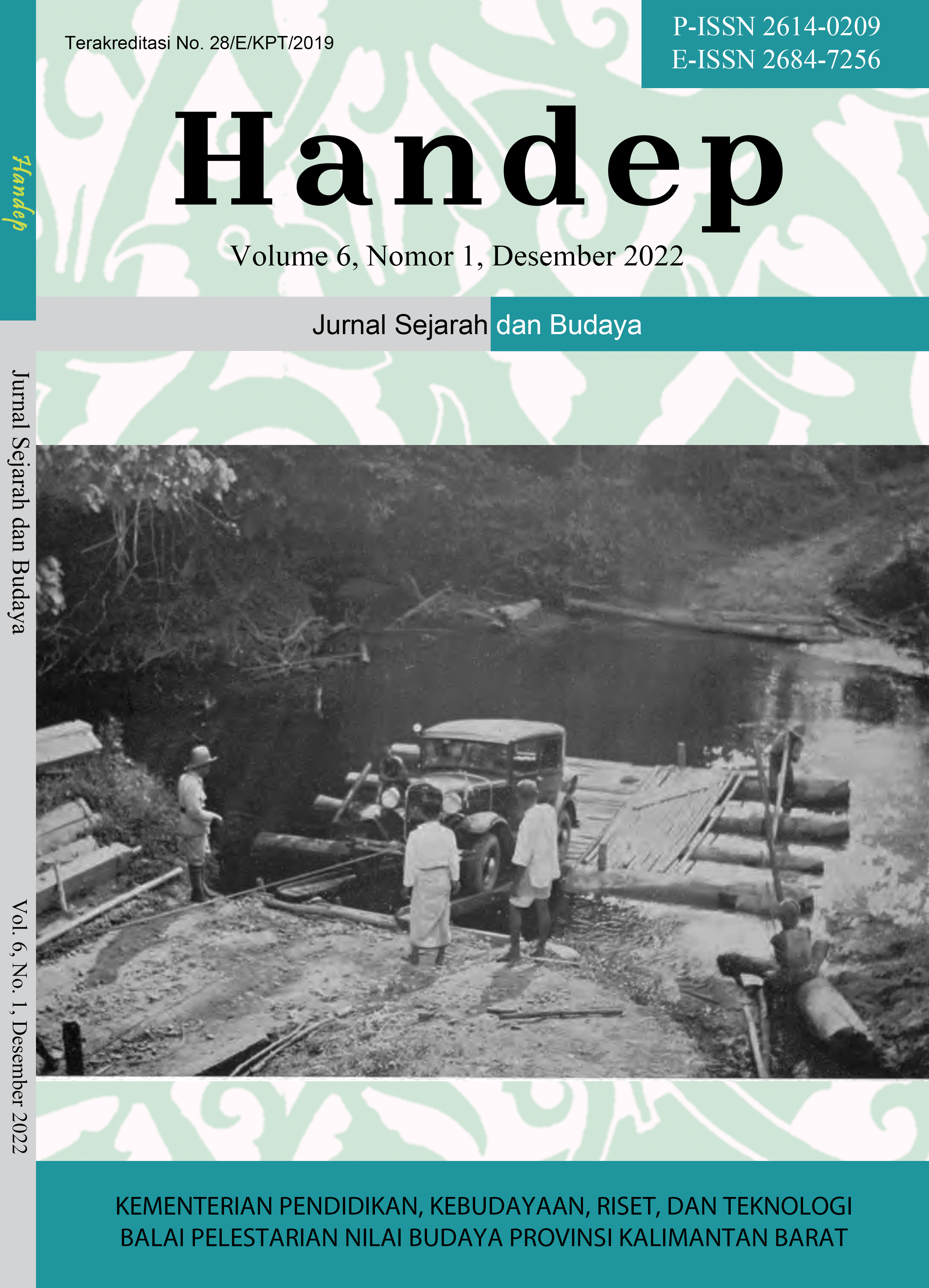
ANTARA “IDE KEMAJUAN” KOLONIAL DAN REALITAS LINGKUNGAN: JALAN RAYA DALAM PEMBANGUNAN PRASARANA PERHUBUNGAN DI PESISIR BARAT KALIMANTAN
DOI:
https://doi.org/10.33652/handep.v6i1.205Keywords:
road, railway, waterway, the “idea of progress”, and transportation infrastructure.Abstract
This paper aims to find out the considerations of the colonial government in building transportation infrastructure to facilitate economic exploitation on the west coast of Kalimantan. For this reason, this paper questions road construction as the only option for the colonial government when faced with the idea of constructing a railway which at that time was the latest trend in land transportation and the environmental realities that had been built, namely waterway. The problem was studied using the historical method with an urban studies approach. The result shows that road construction that is “a middle ground” is in line with “the idea of progress” that was emerging in the Nederland Indies in the context of the New Order (the New Colonial World). The “ideas” consisting of expansion, efficiency, and welfare are detected from (1) the embryo of a coastal road that has been developed since the second half of the 19th century, (2) pacification and supervision for coastal areas which were the former centers of the Kongsi Wars, (3) optimization of economic connectivity, and (4) development of alternative roads.
References
Alamsyah, Alik Ansyori. 2001. Rekayasa Jalan Raya. Malang: UMM Press.
Anonim. 1907. “Electrische Spoorwegen op Borneo,” Bredasche Courant, Agustus, 29.
______. 1917. “Oost-Indie Tramwegen in West Borneo” Het Vaderland, November, 24.
______. 1920. “Pemandangan di Sebahagian Borneo Barat,” Mei, 1.
______. 1923. “De Weg Pontianak Sambas,” Bataviaasche Nieuws blad, Juni, 22.
______. 1928. “Perdjalanan L. Mendeij Hoofd red “O.B’ dari Pontianak Singkawang.” Oetoesan Borneo. Juni, 6.
______. 2020. “Pemerintah Rencana B a n g u n To l P o n t i a n a k - S i n g k a w a n g , To l P e r t a m a Kalimantan Barat.” Merdeka, Maret, 9.
ANRI. Inventaris Arsip Burgerlijke Openbare Werken Grote Bundel 1854-1933 No. 7948. “Stukken Betreffende Reisverslag te Pontianak.”
______. 1933. Memorie van Overgave C. Kater.
______. 2015. Naskah Sumber Arsip Perkeretaapian di Indonesia. Jakarta: ANRI.
Asnan, Gusti. 2002. “Transportation of the West Coast Sumatra in the Nineteeth Century.” Bijdragen tot de Taal-, Land- en Volkenkunde 158 (4):727-741.
Blink. H. 1921. “Economisch Geographie van Borneo’s Wester Afdeeling”. Tijdschrift Economische Geographie:41-58.
Cipta, Hendra, 2019. “Proyek Jalan Tol Pertama Kalbar Jalur Pontianak Singkawang Segera Dibangun.” Kompas Regional, Agustusm 8.
Colombijn, Freek. 2002. “Introduction: On the Road on the Road,” Bijdragen tot de Taal, Land-en Volkenkunde, 158 (4):595-617.
Dick, Howard dan Peter J. Rimmer. 2003. Cities, Transport and Communications: the Integration of Southeast Asia since 1850. New York: Palgrave Macmillan.
Driessche, J. H. van. 1912. “Nota ‘s Betreffende de Landschappen Sambas en Pontianak der Wester Afdeeling van Borneo”. Tijdschrift van het Koninklijk Nederlandsch Aarkundig Genootschap 29 (2).
Historical Section of the Foreign Office. 1920. Dutch Borneo. Handbooks, prepared under the direction of the No. 84. London: H.M Stationery Office.
Elenbaas, W.G. 1909. “West Borneo: Eenige Mededeelingen Aangaande Bevolking en Bestuur”. De Indische Gids 31 (2):913-921.
Encyclopaedia van Nederlandsch Indie (ENI), 1917. Furnivall, J.S. 1967. Netherlands India: A Study of Plural Economy (Reprinted). New York: Cambridge University Press.
Hartatik, Endah Sri. 2014. “The Development of Agroindustry and Transportational Network in the Central Java During Dutch Colonial.” Paramita, 24 (1) Januari 2014: 1-16.
Kielstra, E.B. 1889. Bijdragen tot de Geschiedenis van Borneo’s Westerafdeeling, Jilid 2&3. Legagasann: E.J. Brill.
Mrazek, Rudolf. 2006. Engineers of Happy Land. Jakarta: Yayasan Obor Indonesia.
Mulyana, Agus. 2017. Sejarah Kereta Api di Priangan. Yogyakarta: Penerbit Ombak.
Nowacki, Gabriel. 2013. “Transport Infrastructure as a Potential Target of Terrorist Attacks.” Hlm.185-192 dalam Marine Navigation and Safety of Sea Transportation, disunting oleh Adam Weintrit dan Tomasz Neumann. Boca Raton: Taylor & Francis Group, LLC.
Ozinga, J. 1940. De Economische Ontwikkeling der Wester-afdeeling van Borneo en Bevolking srubbercultuur. Wageningen: N.V. Gebr. Zomer en Keuning’s Uitgevermaatschappij.
Puspitasari, Rika. 2018. “Dampak Sosial-Ekonomi Pembangunan Jalan Raya di Kalimantan Selatan, 1890an-1940.” Skripsi. Fakultas Ilmu Budaya, Universitas Gadjah Mada.
Rahman, Ansar. 2001. Kabupaten Sambas: Sejarah Kesultanan dan Pemerintahan Daerah. Sambas: Pemerintah Daerah Sambas.
Rahmayani, Any. 2021. “Pembangunan Jalan Darat dan Ekspansi Kolonial di Pesisir Barat Kalimantan 1854- 1930an.” Tesis, Fakultas Ilmu Budaya, Universitas Gadjah Mada, Yogyakarta.
Rahmayani, Any, Ina Mirawati, dan Eka Jaya Putra Utama. 2014. Tanaman Niaga di Borneo Barat pada Awal Abad ke-20 (Studi tentang Karet dan Kelapa). Yogyakarta: Kepel Press.
Reitsma, S.A. 1925. Boekoe Peringatan dari Staatspooren Tramwegen di Hindia Belanda 1875-1925, Gedenkboek van Staatspooren Tramwegen van Nederlandsch Indie. Weltrevreden : Topographiesche Inrichting,1925.
Roon, J. van. 1920. De Werkzaamheden van den Topografischen Dienst in de Westerafdeeling van Borneo (1886-1895). Bandung: N.V Boekh Visser & Co.
Sandick, J.C.F. van dan V.J. van Marle. 1919. Verslag Eener Spoorwegverkenning in Noordwest-Borneo. Dienst der Staats-Spoor-en Tramwegen: Albrecht &Co.
Setiyono. Budi. 2015. “Tahu Tetapi Tidak Mau Mengerti: Etnografi tentang Respon Orang Kampung Kalehien, Kalimantan Tengah terhadap Pembangunan Jalan Raya”. Disertasi, Fakultas Ilmu Budaya, Universitas Gadjah Mada.
Touwen, Jeroen. 2001. Extremes in the Archipelago: Trade and Economic Development in the Outer Island of Indonesia, 1900-1942. Leiden: KITLV Press.
Uljee, G.J. 1925. Handboek voor de Residentie Westerafdeeling van Borneo. Weltevreden: N.V. Boekhandel Visser & Co.
Vleming, J.L. 1926. Het Chineesche Zakenleven in Nederlandsch-Indie. Weltevreden: Landsdrukkerij.
Wadley, Reed L. 1998. “The Road to Change in the Kapuas Hulu Borderlands: Jalan Lintas Utara.” Borneo Research Bulletin, 29:71- 90.
Wijono, Radjimo Sastro. 2013. Modernitas dalam Kampung: Pengaruh Kompleks Perumahan Sompok di Semarang Abad Ke-20. Jakarta: LIPI Press
Downloads
Published
Issue
Section
License
By submitting the manuscript of papers/articles to Handep: Jurnal Sejarah dan Budaya, the authors are agreed to the following terms stated in copyright and license. Please also read our Publication Ethics dan Screening for Plagiarism.
Copyright
Authors who wish to publish and disseminate their papers with Handep: Jurnal Sejarah dan Budaya, shall agree to the publishing rights set by Handep: Jurnal Sejarah dan Budaya. Authors understand that they shall assign publication right to Handep: Jurnal Sejarah dan Budaya as part of the process upon acceptance for publication. The authors agreed that they will transfer certain copyrights to Handep: Jurnal Sejarah dan Budaya (authors must transfer the copyright by using the downloaded form HERE). Consecutively, authors still retain the right to use and share their own published articles without written permission from Handep: Jurnal Sejarah dan Budaya, as long as attributed properly, that the articles are initially published at Handep: Jurnal Sejarah dan Budaya.
Authors granted Handep: Jurnal Sejarah dan Budaya these following rights; (1) the right to publish and provide the manuscripts in all forms and media for publication and dissemination, (2) the authority to enforce the rights in the manuscript, for example in the case of plagiarism or copyright infringement.
License
Works in Handep: Jurnal Sejarah dan Budaya licensed under Creative Commons Attribution license. Users are free to copy and redistribute the material in any medium or format, remix, transform, and build upon the material under these terms; users must give appropriate credit, provide a link to the license, and indicate if changes were made. Users may do so in any reasonable manner, but not in any way that suggests the licensor endorses users or their usage.